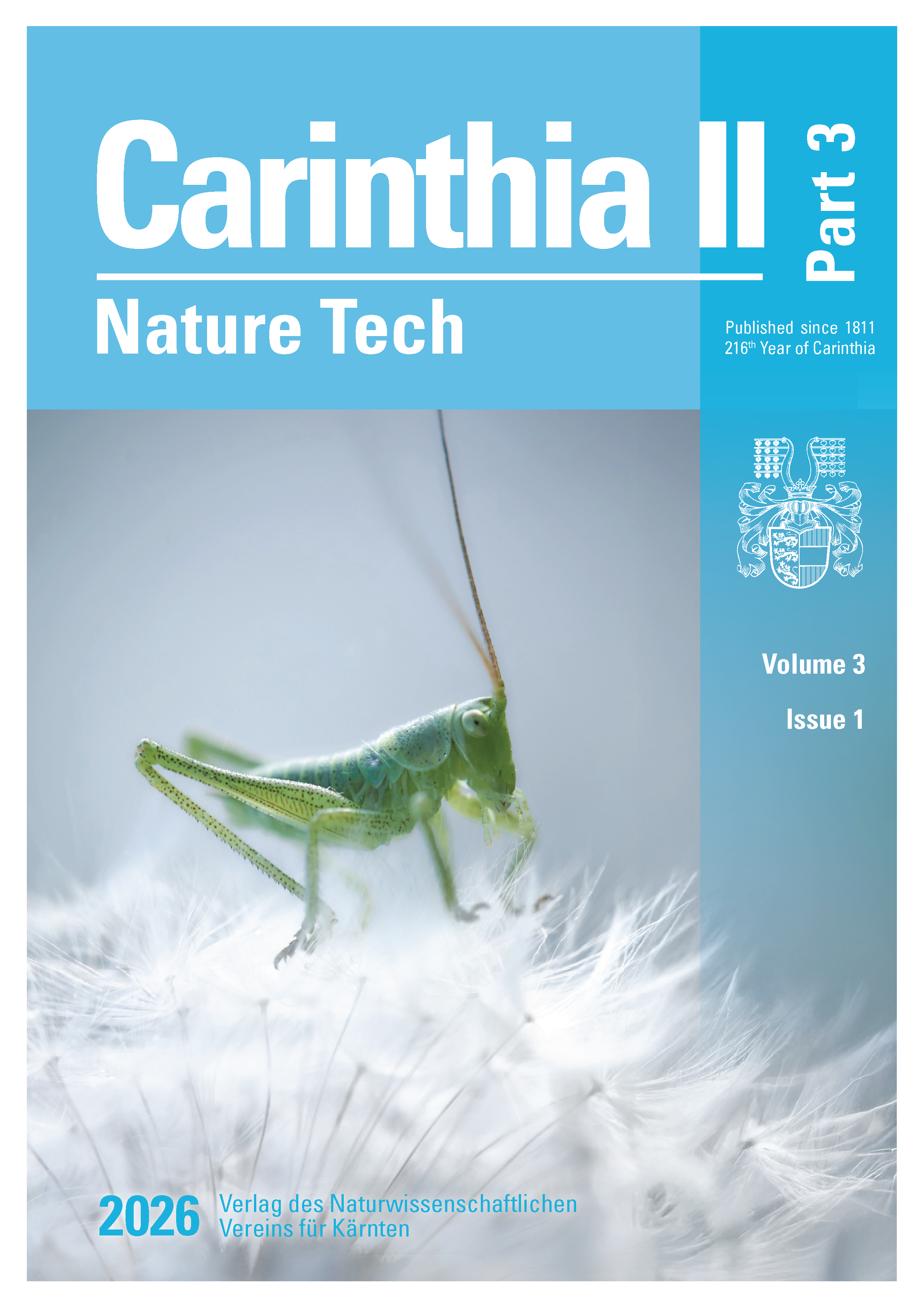
Carinthia Nature Tech (Carinthia II - Part 3) is a scientific journal dedicated to the application of disruptive technologies in the field of nature conservation. The journal aims to feature advanced testing, research, and development of novel technologies for recording and analyzing biodiversity, including species, populations, habitats, and ecosystems. It also covers monitoring geological, hydrological, and climatic systems, and innovative methods to monitor environmental pressures.
Current Issue
Vol. 3 No. 1 (2026): Carinthia II - Part 3 | Carinthia Nature Tech
In the peer-reviewed sections, engagement of young scientists is visible through an information technology internship program that occurred at University of Klagenfurt. Analysis of long-term camera trap survey data reveals presence of non-target mammals and birds in Carinthia. Trends of visitor activity are documented through a GPS tracking survey in a Carinthia trans-boundary UNESCO GeoPark. In the Short Notes, results of land use change in an Ethiopian biosphere reserve are documented using satellite remote sensing. Diverse ways to monitor local agrobiodiversity are showcased. Lastly, two Book Reviews round out the issue, with one review on grasshoppers of Carinthia, and one review on the habitats of Europe.
Full Articles
Interdisciplinary approaches exploring the connection between biology and technology through slime mold simulation
Slime molds are fascinating organisms that, despite their name, are not fungi but amoeboid protists. Among them, the plasmodial slime mold Physarum polycephalum forms a multinucleate syncytium, known as the plasmodium, through repeated nuclear divisions without cytokinesis. In this phase, the organism appears as a viscous network-like mass containing millions of nuclei and is capable of solving complex tasks, such as navigating mazes, through self-organized behavior. Additionally, P. polycephalum is easy to culture and handle, making it an ideal model organism for studying self-organization, adaptive behavior, and biological network formation. The Smart Grids research group in the Department of Networked and Embedded Systems (NES) at the University of Klagenfurt conducts research involving slime molds. Specifically, the group investigates the potential of self-organizing applications in energy networks.
In cooperation with the Austrian Research Promotion Agency (FFG), the Faculty of Technical Sciences at the University of Klagenfurt offers Austrian students aged 15 and older the opportunity to gain insight into university-level research through a four-week summer internship. The project “Experiments with Slime Molds” was offered for the second time in 2024 by the Smart Grids research group. This interdisciplinary project allows participants to explore the intersection of biology and computer science. The internship offers participants the chance to explore the interfaces between biology, computer science, and mathematics. It is especially aimed at students interested in biological systems, the application of mathematical models, and the development and use of software tools for simulating natural phenomena. The interns begin by cultivating slime molds in Petri dishes and then simulate their behavior using SISMO (Simulation of Slime Molds), a tool developed by the Smart Grids group.
This article explores how biology and technology were combined in a four-week internship program and provides insights into the individual experiments conducted. A central element is the report by intern Viviane Elmenreich, who shares her experiences from the 2024 IT internship at the University of Klagenfurt. The focus of the internship was on biological experiments with the slime mold P. polycephalum, including the cultivation and reactivation of sclerotia, analysis of information processing within the plasmodium, and observations of behavioral and color response to stimuli. These experiments were complemented by technical components, such as programming a Raspberry Pi to automate time lapse photography and using the simulation tool SISMO to model slime mold behavior. The results demonstrated that slime molds are capable of absorbing information from their environment, processing dyes from food sources, and finding efficient paths to nutrients, both in physical experiments and in simulated environments. Furthermore, the combination of hands-on and digital approaches enabled deeper insights into the principles of biological self-organization. The internship not only contributed to the development and refinement of the SISMO simulation tool but also played a key role in enhancing the scientific education of the participants. The students gained valuable skills in experimental biology, programming, documentation, media production, and interdisciplinary research. These experiences fostered scientific thinking and also served as a strategic investment in talent development and in strengthening the University of Klagenfurt’s position as an innovative research institution.
Page 8-23 | doi: https://doi.org/10.71911/cii-p3-nt-2026311
From wildlife management to biodiversity assessment Using camera trap by-catch data to infer species richness
Camera traps are widely used in wildlife management to monitor focal species such as ungulates. However, the large amount of data on non-target species is rarely analyzed systematically. In this study, we examine whether management-oriented camera trap surveys can be used to infer broader biodiversity patterns. Using camera trap data from four study sites, we recorded 57 species, including 25 mammals and 32 birds. Species richness varied between sites but this was not primarily driven by total sampling effort. Despite substantially greater effort invested, a long-term opportunistic survey detected only slightly more species than a short-term survey using systematic random placement, consistent with spatial coverage, camera density and area size jointly influencing species detection rather than sampling duration alone. We analyzed species accumulation using Michaelis–Menten models fitted to taxa that could be reliably detected by camera traps. Systematic random surveys reached species saturation more rapidly and exhibited faster accumulation than opportunistic designs. The proportion of mammal species listed under the EU Habitats Directive remained consistent across sites, suggesting that camera traps can effectively detect species of conservation significance, even when deployed for management purposes. Late detections of rare or hard-to-detect species disrupted saturation at one site, illustrating the sensitivity of accumulation models to detectability. Overall, our results suggest that camera trap surveys targeting specific species can provide valuable additional information on biodiversity, and that by-catch data should be systematically integrated into wildlife monitoring programs. Systematic random designs may offer efficiency advantages for species inventories, although this comparison is observational and confounded by differences in area size and camera density.
Page 24-40 | doi: https://doi.org/10.71911/cii-p3-nt-2026312
Short Articles
Implementing GPS logger data for visitor monitoring in the Karawanken–Karavanke UNESCO Global Geopark
Human-Nature coexistence is an increasingly important component in the sustainable management of conservation areas. Pioneering conservation approaches are focused on integrating these two aspects rather than creating a strict separation. Disruptions to the balance between humans and nature can affect both natural resource conservation and the tourist experience. To avoid this, resource, infrastructure, and tourism flow management plans are needed. The HUMANITA project aims to develop innovative solutions to monitor tourism and its impact on the environment within selected conservation areas in Central Europe. It includes several methods to estimate tourism numbers, hotspots, and activities. We distributed 69 GPS loggers in the Karawanken–Karavanke UNESCO Global Geopark and created visitor density and intensity maps. This study demonstrates that GPS logger tools can support science-based management in conservation areas by providing quantitative insights for managing tourism flows. However, part of our objective is also to highlight key limitations, including low tourist participation, technical challenges, and concerns related to the high spatial resolution of the data in the UNESCO Global Geopark.
Page 42-54 | doi: https://doi.org/10.71911/cii-p3-nt-2026313
Short Notes
Advancing biodiversity research in the agroecosystem Project BioMonitor4CAP in focus
The EU Biodiversity Strategy 2030 recognizes farmers’ dual role in safeguarding and impacting biodiversity. Within this policy context, the Horizon Europe project BioMonitor4CAP addresses monitoring of agroecosystem biodiversity and stakeholder-informed policy design to contribute perspectives and guidance in advance of the next Common Agricultural Policy period. The project integrates above- and below-ground indicators—pollinator insects, farmland birds, soil microbiota, and landscape structure—by pairing traditional methods with state-of-the-art tools across a network of European research sites. In Carinthia, six sites spanning low-elevation and high-elevation areas are used for testing traditional and state-of-the-art workflows targeting farmland birds, pollinator insects, soil communities, vegetation plots, and landscape structure. Sampling timing is based on a growing degree-day (GDD) approach. Carinthia University of Applied Sciences leads regional implementation, device feasibility testing, GDD scheduling, and remote sensing case studies, contributing to systematic reviews, indicator frameworks, and data infrastructure. A socio-economic component of the project engages farmers, advisors, and policymakers through focus groups, co-creation workshops, and a discrete choice experiment on subsidy trade-offs, complemented by mapping a Europe-wide network of ~600 agrobiodiversity observatories. Early findings highlight operational feasibility, ethical considerations, and context dependence of methods; regulatory and site constraints necessitated adaptive designs. BioMonitor4CAP is synthesizing evidence to deliver results-based monitoring guidance and policy options that reconcile practicality of monitoring approaches with conservation effectiveness. The project underscores that no single measure fits all farms, but co-designed, evidence-based approaches can align agricultural production, biodiversity outcomes, and circular economy goals for Europe.
Page 56-65
Integrating remote sensing and in situ data to assess wetland ecosystem health within the Pressure-State-Response (PSR) framework in Lake Tana UNESCO Biosphere Reserve, Ethiopia
The Lake Tana Biosphere Reserve (LTBR) consists of wetlands that provide critical ecosystem services but face degradation from anthropogenic pressures and climate change. This study integrates the Pressure-State-Response framework with multi-temporal remote sensing (Landsat and Sentinel2, 2011–2025) and participatory citizen science. Landscape metrics (patch density, Shannon diversity index, net primary productivity) were derived alongside demographic and infrastructure layers to assess pressures. Quantitative data were triangulated with focus group discussions and participatory mapping. Results show that high population density (up to 13,000 individuals/km²) and cultivated land expansion (78% to 85% from 2011 to 2025) are primary degradation drivers, manifesting as landscape fragmentation and declining vegetation productivity especially in the eastern floodplain areas of LTBR. Integrating spatial analysis with local knowledge reveals spatially differentiated wetland vulnerability shaped by demographic, agricultural, and climatic factors. This approach demonstrates the feasibility of fusing objective spatial data with participatory evidence, offering a scalable model for evidencebased conservation policy in the LTBR and other sensitive wetland systems.
Page 66-73